
The gap between the demo and the work
Benchmarks used to mean something. Not so much anymore. Stanford’s 2026 AI Index found frontier labs disclosing less about their own models, right as the benchmarks meant to hold them accountable saturate faster than anyone can write new ones1. Pull up any public leaderboard today and the top models sit within a couple of points of each other. That’s not close competition. That’s a ruler that stopped measuring anything useful.
If the scores still predicted what happens once a model actually ships, none of this would matter much. They don’t. One report this year put the gap between benchmark scores and real deployment results at 37 percent for enterprise agentic systems, with a 50x difference in cost between two systems landing on roughly the same accuracy. Frontier models are failing about one in three production attempts, and getting harder to audit while labs say less about how they work2.
The leaderboard stopped measuring the thing companies actually pay for: whether a system does its job reliably, at a price that makes sense for that job.
Scaling laws were never going to be the whole answer
There’s a deeper reason to doubt the raced-to-scale approach, and it isn’t new: the scaling laws behind it are running into real limits.
Ilya Sutskever, one of the people who did more than almost anyone to prove scaling worked in the first place, said at NeurIPS 2024 that pretraining as we’ve known it is ending. His reasoning was blunt: data is the fossil fuel of AI, and the field has burned through most of what’s easily available3. Chinchilla-optimal training for a 1 trillion parameter model needs something like 20 trillion tokens. The public internet has already been scraped close to dry, and there’s no second internet waiting to be found4.
Even where data isn’t the bottleneck, the returns are flattening. Research tracking model size against performance finds knowledge tasks plateauing past 30 billion parameters and reasoning tasks plateauing past roughly 70 billion. What looked exponential for a few years now reads more like an S-curve: each added billion parameters buys a little less than the last one did. Smaller models are also catching up faster than the scaling story predicted. Falcon 180B, a 2023 flagship, was outperformed within a year by Llama 3 8B, a model more than twenty times smaller, mostly through better training technique rather than more scale5.
None of this means scale stops mattering. It means scale stopped being the whole answer years before most of the industry’s spending caught up with that fact.
The bill for chasing the number
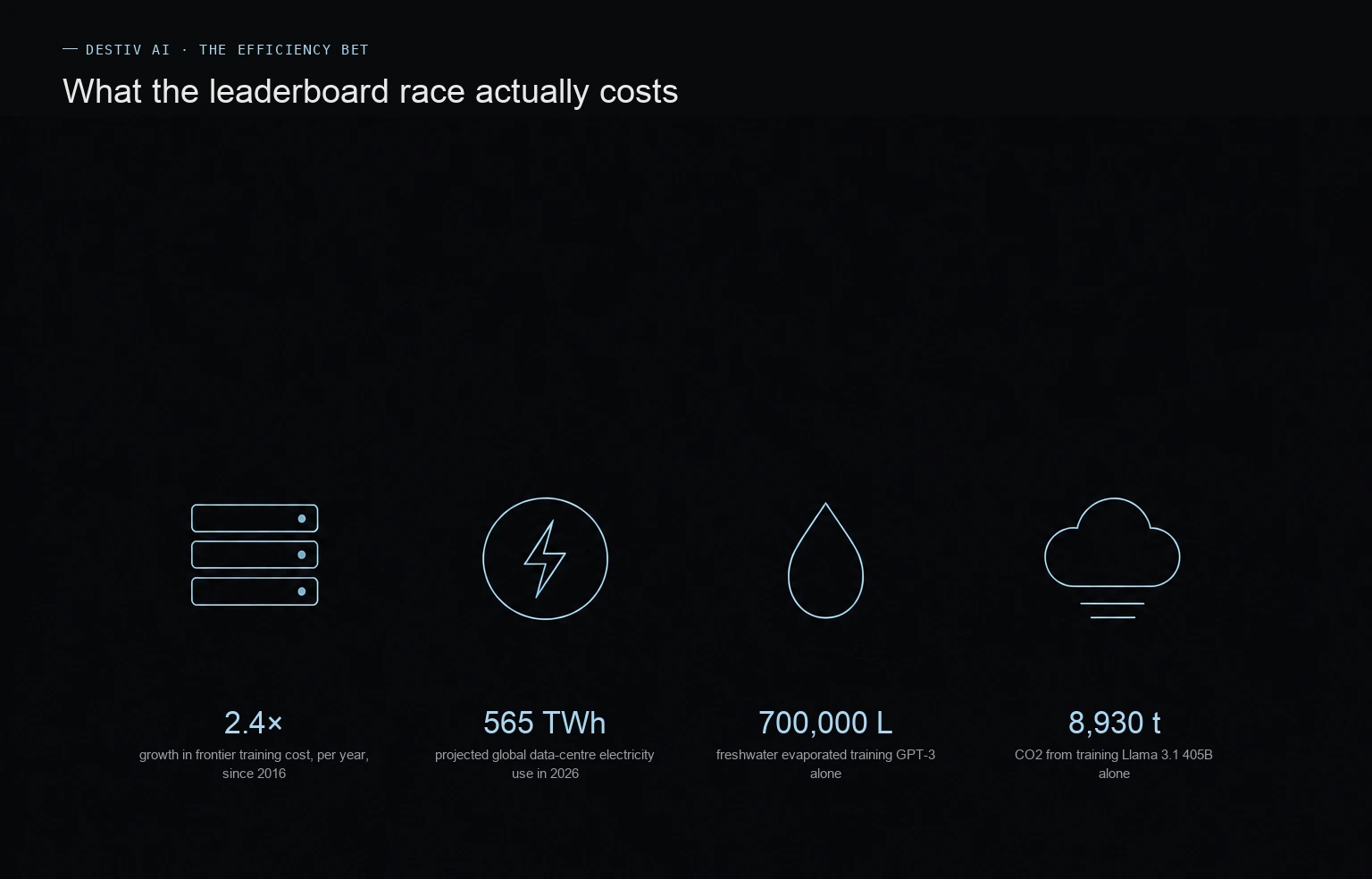
None of this comes free. Frontier training costs have grown roughly 2.4x a year since 2016. At that pace, a single training run is on track to cost more than a billion dollars by 20276. Data centres, most of them built out for AI, are projected by the IEA to draw around 565 terawatt-hours of electricity globally in 2026, up 26 percent in a single year. Some industry trackers put the real figure, once every workload is counted, closer to 1,000 TWh, in the range of an entire country the size of Japan7.
And it drinks, too, which gets talked about far less than it should. Training GPT-3 alone evaporated something like 700,000 litres of clean freshwater directly out of Microsoft’s US data centres, by outside researchers’ estimates8. The companies tend to quote the smallest defensible number: Sam Altman has said an average ChatGPT query costs about 0.32 millilitres of water, counting only the water used on-site for cooling. Independent researchers who also count the water used to generate that electricity in the first place put a single GPT-4-class query closer to 10 millilitres, something like thirty times higher9. Multiply either number by the billions of queries running every day and you’re looking at a real draw on freshwater, often in places that don’t have much to spare.
Meta’s own model card for Llama 3.1 405B lists roughly 8,930 tonnes of CO2 for that one training run10.
Frontier training run cost, 2017 to 2027 (log scale)
Solid points are reported or estimated figures (Stanford AI Index, Epoch AI)11. The 2027 point is a projection from the reported 2.4× per year growth rate, shown hollow and dashed.
That’s the price of a race whose finish line, per everything above, stopped correlating with what the model is actually good for once it ships.
The privacy cost of centralising everything
There’s a cost here we skipped over, and it matters as much as the electricity and the water: privacy.
Every prompt sent to a centralised frontier model leaves your infrastructure and lands on someone else’s. A 2026 industry report found that over a third of the corporate data employees now paste into AI tools is sensitive, up from about a tenth just two years earlier, and that sensitive information shows up in roughly two out of five AI interactions. Most of that goes through personal accounts, outside whatever controls a company thinks it has in place. Businesses that had an AI-related security incident reported paying close to five million dollars on average to clean it up12.
Policy promises don’t always hold once a company gets pulled into court, either. In January 2026, a federal judge upheld an order requiring OpenAI to hand over 20 million de-identified ChatGPT logs as evidence in a copyright case, after OpenAI’s own attempt to hand over a smaller, cherry-picked set was rejected13. Whatever a prompt said, if it sat in a big enough pool of data at a big enough company, it could end up as a line item in someone else’s lawsuit.
To be fair, some of this is shifting. OpenAI began offering zero data retention for frontier model API customers in August 2026: eligible enterprise prompts aren’t stored or used for training at all14. We think that’s a genuine improvement, and also a quiet admission that the default arrangement, prompts retained, reviewed and pooled into training data, was a real problem worth building a special mode to opt out of. A system that has to be specially configured not to hold onto your data is still a system built, by default, to hold onto it.
Keep sensitive work on infrastructure you control, or on a model small enough to run there yourself, and most of this risk just disappears. For plenty of businesses, especially the ones handling financial records or client data, that isn’t a side benefit of building this way. It’s the main reason to.
The proof is already inside their own models
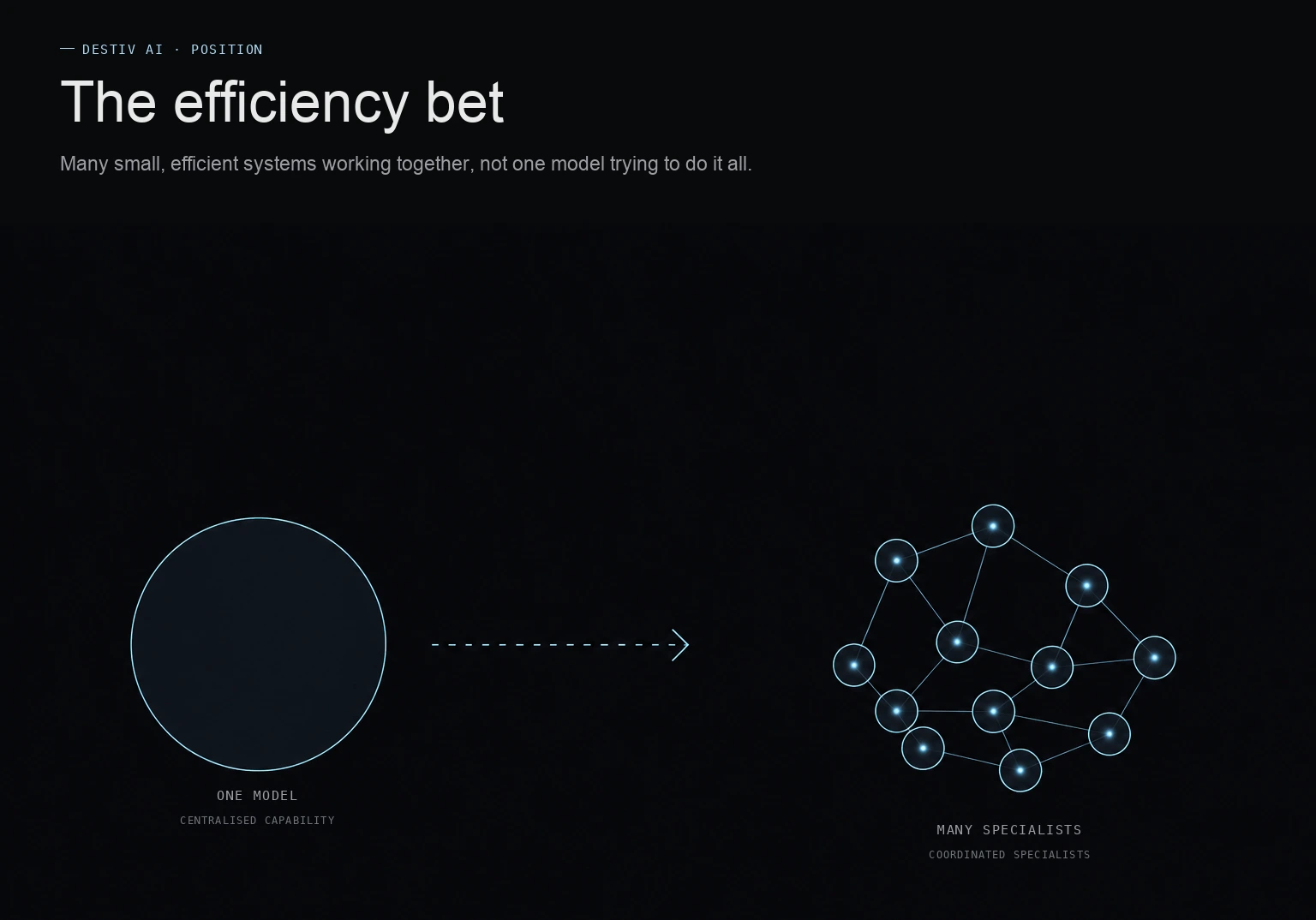
Here’s the part that gets us: the same labs running this race have basically already agreed with us, just quietly, inside their own architecture. Mixture-of-experts is now the default design for nearly every serious open-weight model out there: DeepSeek, GLM, Kimi, Qwen, MiniMax, all of them15. Instead of firing up one dense network for every request, the model routes each token to a handful of specialists out of many, and leaves the rest idle. You get near-frontier ability for a fraction of the compute per answer.
DeepSeek-V3: active parameters per token, out of the full model16
We read that as more than a clever trick. A coordinated set of narrow specialists beating one generalist doing everything, at the same cost, isn’t a fringe idea anymore. It’s how most of the best models on earth are already built. We just don’t see why that logic should stop at the edge of one company’s model weights. Experts inside one network, trained together in one run, is sparsity. It isn’t decentralisation. Our bet is that the same principle holds a level up: when the “experts” are separate systems, built by separate teams, running on separate infrastructure, and coordinated by an agent layer instead of a router baked into one set of weights.
The same bet, in the architecture itself
Some of why this all costs so much is just math. In a standard transformer, attention cost grows quadratically with context length: double the context, quadruple the compute. Most of the industry’s biggest bets have simply paid that bill, over and over, at increasing scale.
Relative compute cost as context length doubles
Illustrative, from each architecture’s known compute scaling, not a specific model’s measured benchmark.
A quieter corner of research spent 2026 questioning the math instead. Mamba-3, out of Princeton this year, is the clearest recent step in state-space and linear-attention models that keep memory and compute close to constant as context grows, instead of exploding17. It’s not a finished win. The researchers themselves admit transformers still lead on pure retrieval, and earlier sub-quadratic models gave up real quality, especially on state-tracking, to get their efficiency gains. But it tells you something that serious architecture work is now chasing intelligence per watt instead of parameter count, and mostly outside the labs setting the benchmark pace.
DeepSeek’s own trajectory tells the same story from a different angle. DeepSeek-V4 replaced the multi-head latent attention in its previous model with a hybrid design: standard attention on most layers, and two flavours of compressed sparse attention doing the heavy lifting on the rest, alongside a new optimiser built for training stability at this scale. At a million-token context, the result needs only about a quarter of the inference compute and a tenth of the memory that the previous version needed for the same job18. That’s not a lab chasing a bigger number. That’s a lab already near the top of the leaderboard choosing to spend its next generation of research on using less, not more.
Open models are already living our argument
None of this is theoretical, either. Open-weight models you can run, inspect and combine yourself are now close enough to closed frontier performance that most real work doesn’t need to wait on whoever’s topping this month’s leaderboard. DeepSeek V4 matched or beat GPT-4o on most standard benchmarks this year, and usage trackers now show DeepSeek and Qwen serving more inference tokens than several closed competitors19.
We’ll be straight about the limits of this too: open weights aren’t the same thing as decentralised power. The compute needed to train a frontier-class open model still sits with a handful of well-funded organisations. But the fact that models anyone can download now do most of the useful work makes our case in practice, not just in theory. You don’t need one company’s proprietary, centrally-run model to get something genuinely useful built.
Why we think one “AGI” is a risk, not only an inefficiency
Everything above is an efficiency argument. This one isn’t, and we think it matters more.
The World Economic Forum has ranked technological power concentration as one of the fastest-rising risks in the world, in back-to-back years20. The specific danger researchers keep pointing to: whoever gets there first with a system better than any human at persuasion, strategy and coordination at once doesn’t just own a product. They own a kind of leverage no market or election currently knows how to check21. Metaculus, a forecasting platform people actually trust on these calls, puts AGI at 25 percent likely by 2029 and 50 percent by 203321. That’s inside a decade. Not science fiction.
Even a perfectly safe, perfectly well-behaved centralised AGI would still put an unprecedented amount of capability, and the money and compute needed to build it, inside one organisation.
That’s a structural problem regardless of whether the model itself ever does anything wrong. A world with many smaller systems, each built for a bounded job, each replaceable, each auditable against a standard narrow enough to actually check, doesn’t create that single point of control. Even if none of those systems, on its own, is ever quite as capable as the one giant model might eventually become.
The honest countercase
We should say the other side plainly, because we’re not brushing it off. We just disagree with it.
Frontier labs aren’t actually ignoring efficiency. Inference cost per token at the frontier has fallen 3 to 4x a year, a real gain running right alongside the scaling2. And some problems, wide-open scientific reasoning, long agentic work with no fixed shape, might genuinely need a kind of capability that a bunch of narrow specialists can’t yet match just by coordinating well.
Worth being precise about one name that gets cited a lot on our side of this. Yann LeCun has argued for years that scaling transformers won’t get anyone to general intelligence. We agree with that part, and we’ll happily cite him for it. But his own answer, the world-model work he’s now building at AMI Labs, is itself one big, centralised bet on a different architecture. It isn’t an argument for decentralisation22. We’re borrowing his critique of scaling, not the rest of his plan.
We hold this position because we think it’s right, not because it’s settled. Coordinating a lot of specialised systems reliably, routing work correctly, sharing context without leaking it, keeping latency sane, building trust between systems different teams built, is itself an unsolved, genuinely hard problem. Our bet is that it’s a more tractable problem, and a safer one to get wrong, than putting everything behind one system built to be good at all of it.
What this means for how we build
We should be straight about something before we go further. We’ve used frontier models ourselves, and we still do, in places where one is genuinely the right tool for the job today. Nothing above is a claim that we’ve never touched one. It’s a direction we’re moving in, deliberately, project by project, not a line we’ve already crossed.
This is the whole reason Destiv is built the way it is. The Agentic OS coordinates specialised agents, each one doing a single part of a job well, calling whichever model actually fits that job instead of routing everything through one system that claims to do it all. Desynagent’s agents each own one piece of building a brand.
Ledgize is probably the clearest example of where this is heading. Its core reconciliation and accounting work runs on rule-based software, not a frontier model at all: matching, calculations and checks that follow clear logic and give the same answer every time. That’s most of the work, and it costs a fraction of what a model API call would, precisely because it never makes one. It’s also more accurate in a specific, unglamorous way: rules don’t hallucinate a figure that looks plausible and isn’t. They either match a transaction correctly or they flag it for a person. Only the genuine exceptions, the ones the rules can’t resolve, go to a small model running on infrastructure Ledgize controls, never out to a frontier API. A client’s bank statements and ledgers never have to leave the building to get reconciled. That’s not a compliance checkbox we added afterward. It’s what the hybrid architecture is actually for, and it’s cheaper, more accurate on the bulk of the work, and safer with the data, all at once.
We think this is where AI actually has to go, not just where we’d like it to go: smaller, specialised, efficient models, each good at one thing, working together, instead of one lab’s model trying to be everything to everyone. That version of this technology doesn’t need to burn a small country’s worth of power and water to get a job done, and it doesn’t hand one organisation more leverage, or more of your data, than any single institution should hold.
We’d rather build a hundred things that are each good at one job than bet everything on one thing that claims to be good at all of them.